
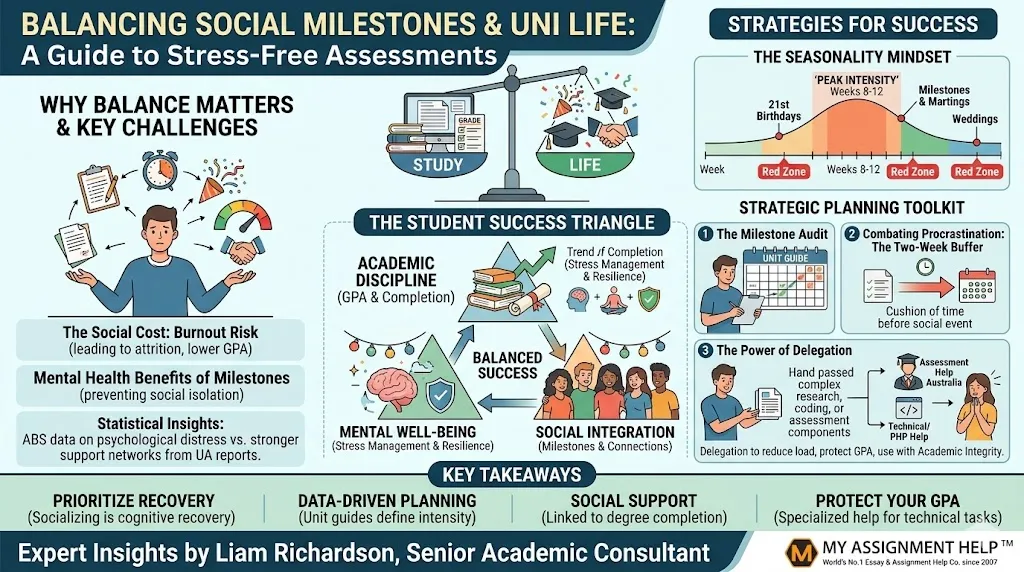
The university years in Australia are a unique paradox: they are simultaneously the most academically demanding and the most socially significant years of a person’s life. From 21st birthday celebrations in Melbourne to coastal weddings in Perth, the Australian social calendar is relentless. However, for a student, these “joyous wishes” often clash with the rigid deadlines of mid-semester assignments and final examinations.
Finding the equilibrium between high academic performance and a fulfilling social life isn’t just about time management; it’s about psychological resilience. According to data from the Australian Bureau of Statistics (ABS), a significant percentage of young adults experience high levels of psychological distress, often citing study-life imbalance as a primary trigger. To navigate this, students must treat social milestones not as distractions, but as essential rewards for academic discipline.
The Social Cost of Academic Pressure
Many students believe that “grinding” through the weekend is the only path to success. However, research into the “Recovery Experience” suggests that total detachment from study during social events actually improves cognitive function for the following week. When you are constantly worrying about a looming deadline while at a friend’s engagement party, you are neither effectively studying nor effectively celebrating. This “middle-ground anxiety” leads to burnout—a leading cause of course attrition and issues with GPA maintenance.
To mitigate this, students are increasingly looking for external support systems to maintain their lifestyle. For instance, when the pressure of multiple units becomes overwhelming, utilizing a professional assessment help australia service to manage your load can provide the necessary breathing room to attend significant family gatherings. By delegating complex research components to experts who understand the nuances of academic integrity, students can protect their mental health without sacrificing their grades.
Why Milestones Matter for Mental Health
In Australia, the university experience is a rite of passage. Missing out on “Schoolies,” graduation dinners, or milestone birthdays can lead to a sense of social isolation. Recent reports from Universities Australia highlight that students with strong social support networks are significantly more likely to complete their degrees compared to those who isolate themselves.
Social milestones provide a “mental reset” that balances the heavy analytical lifting required in the classroom. However, for students in high-stakes technical degrees, the pressure is even more acute. A student might breeze through a humanities essay, but technical tasks like PHP Assignment Help require deep, uninterrupted focus. If a wedding falls on the same weekend a coding project is due, the financial stress of failing a unit—especially with rising HECS-HELP debts—can be paralyzing.
Strategic Planning for the Australian Academic Calendar
Success in the Australian university system requires a “Seasonality Mindset.” The semester typically peaks in intensity during Weeks 8 through 12.
- The Milestone Audit: Map out your social calendar against your unit guide at the start of the semester. If your best friend’s 21st is in Week 10, that is your “Red Zone.”
- Combating Procrastination: Use the “Two-Week Buffer” rule. Aim to finish coursework two weeks before a major social event to allow for unexpected technical glitches or extra feedback sessions.
- The Power of Delegation: Recognize when a task is outside your current bandwidth. Professional support is a resource management tool, ensuring you don’t fall behind during peak social seasons.
Key Takeaways
- Prioritize Recovery: Socializing is a form of cognitive recovery that prevents long-term academic burnout.
- Data-Driven Planning: Use your unit guide to identify “high-intensity” weeks early in the semester.
- Social Support: Maintaining relationships is statistically linked to higher university completion rates in Australia.
- Protect Your GPA: Use specialized help for technical tasks to manage HECS-HELP outcomes effectively and reduce graduation stress.
FAQ Section
Q: How do I handle a deadline that falls exactly on a major social event?
If the deadline cannot be moved, the best approach is to start the assessment three weeks in advance. If the complexity is too high, consider professional academic support to handle the heavy lifting while you focus on the core concepts.
Q: Is it okay to take a whole weekend off from studying?
Yes. In fact, “Total Detachment” is a recognized psychological strategy that prevents burnout. As long as you have a structured plan for the weekdays, a weekend off can actually boost your productivity.
Q: Does using academic assistance affect my academic integrity?
Not if used correctly. Professional assistance should be treated as a study guide, tutoring resource, or a research foundation to help you understand complex topics better and improve your own writing.
About the Author
Liam Richardson is a Senior Academic Consultant at MyAssignmentHelp. With over a decade of experience in the Australian higher education sector, Liam specializes in student workload management and curriculum strategy. He has helped thousands of students navigate the complexities of university life by providing actionable advice on balancing rigorous academic standards with personal well-being. When not consulting, Liam is an advocate for mental health awareness within Australian campuses.
References
- Australian Bureau of Statistics (2025). National Survey of Mental Health and Wellbeing.
- Universities Australia (2026). Student Equity and Success Report.
- Journal of Australian Higher Education (2025). The Impact of Social Integration on Student Retention.
